


Mental health telehealth has moved beyond simple video consultations. Today, digital platforms can connect patients with practitioners, manage electronic health records, track changes in emotional well-being, and support ongoing care between appointments. As these platforms become more advanced, AI is also taking on a growing role in how information is analyzed and how patients stay engaged with their care. For mental health professionals, the value of AI is not about replacing clinical judgment. It is about helping them work with information more effectively and giving patients more consistent support between sessions.
1. From telehealth to connected mental health platforms
Traditional telehealth platforms mainly focused on enabling remote communication between patients and healthcare providers. While video consultations remain important, mental health care often involves much more than a scheduled appointment. Video-based educational resources can also be made more engaging with tools such as lip sync ai, which can help create talking videos with synchronized speech.
Patients may need to complete assignments, track their emotional state, access educational resources, or follow treatment recommendations between sessions. At the same time, practitioners need access to relevant patient information without having to manage data across multiple disconnected systems.
This has led to the development of more connected mental health platforms that combine patient-facing mobile applications with practitioner-facing electronic health record functionality. AI can add another layer by helping process data, personalize user experiences, and automate certain routine activities.

2. How AI is changing mental health telehealth
2.1. More personalized patient engagement
Patients do not all respond to the same type of content or reminders. AI can help telehealth platforms personalize interactions based on available user data and previous activity.
For example, a platform may provide relevant mental health resources or reminders based on a patient’s current engagement and assigned activities. This can make digital support feel more relevant than sending the same message to every user.
Personalization can also encourage patients to stay engaged between appointments, which is particularly important in mental health care, where progress often depends on activities and habits outside the consultation itself.
2.2. Better use of ongoing patient and engagement data
Mental health platforms can collect various types of information about a patient’s emotional well-being and engagement. Without appropriate tools, practitioners may have to review large amounts of data manually.
AI and data analytics can help organize this information and highlight useful patterns. Instead of simply storing data, the platform can make it easier for professionals to understand changes over time and use that information as part of their clinical workflow.
This does not mean that AI should make clinical decisions on behalf of professionals. Its role can be to make relevant information easier to access and interpret, while the practitioner remains responsible for assessment and care decisions.
2.3. Automated reminders and digital support
Following a treatment plan often involves activities outside the consultation room. Patients may have assignments, exercises, or other tasks to complete between sessions.
Telehealth platforms can automate reminders for these activities, reducing the need for practitioners to send every reminder manually. When combined with AI-powered personalization, these interactions can be adjusted to better match the user’s needs and engagement.
This is a relatively simple use of AI, but it can have a practical impact on how consistently patients interact with a digital care platform.
2.4. Access to AI-powered mental health tools
AI can also expand the range of digital tools available within a mental health platform. These may include guided resources, educational content, or other tools designed to support patients outside professional consultations.
The important point is that such tools should complement professional care rather than present themselves as a replacement for a mental health professional. Clear boundaries around what an AI tool can and cannot do are particularly important when dealing with sensitive mental health situations.
3. Security cannot be an afterthought
The use of AI in mental health also creates an important challenge: protecting sensitive health information. Mental health platforms may handle personal details, clinical records, emotional well-being data, and information shared during care. A security problem can therefore have serious consequences for both patients and healthcare organizations.
For this reason, security needs to be considered throughout the development of the platform. Encryption, access controls, authentication, secure data handling, and appropriate compliance measures all play a role in protecting patient information.
AI systems also need careful consideration around data access and privacy. Healthcare organizations should understand what information an AI feature uses, where that information is processed, and how access is controlled.
4. A real-world example from Australia
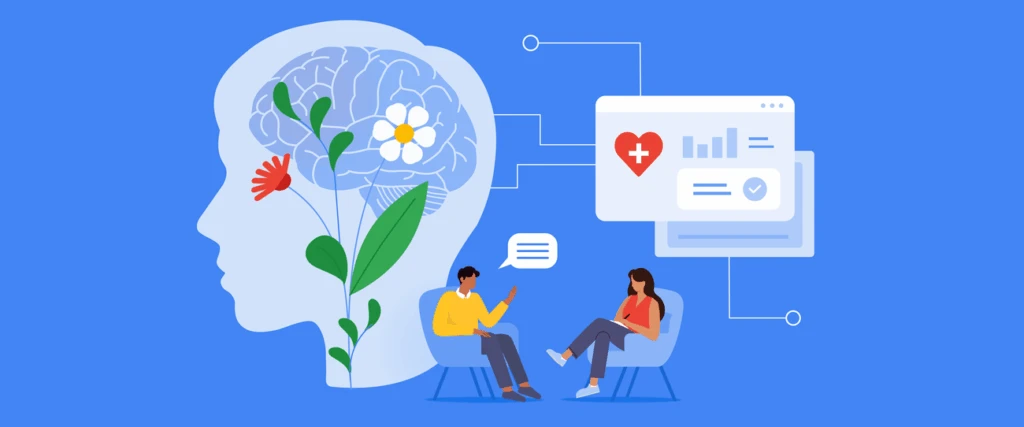
One example of this approach is a telehealth platform developed for mental health professionals in Australia. PowerGate Software collaborated with the client’s internal development teams to build a solution combining a mobile health application for clients with a web-based EHR system for practitioners.
The platform was designed to help professionals review patient-reported information and engagement data, manage digital care activities, and provide access to mental health resources. AI-enabled features supported personalization and digital engagement, while the practitioner remained responsible for clinical assessment and care decisions.
Because the platform handles sensitive health information, security and privacy were important considerations throughout development. The solution incorporated measures such as encryption and layered access controls to help manage access to sensitive information and reduce security risks.
According to the project case study, the platform received positive feedback from participating mental health professionals. Its practitioner-focused interface, digital resources, and personalization capabilities were designed to support a more connected experience for both professionals and patients.

5. What healthcare organizations should consider
AI can add useful capabilities to a mental health telehealth platform, but adding AI alone does not make a platform effective. Healthcare organizations need to consider how each feature fits into the actual workflow of practitioners and patients.
Data privacy and security should be considered from the beginning. Mental health platforms handle sensitive information, so organizations need to establish appropriate security measures, access controls, and data-handling practices before development begins.
The platform should also fit existing healthcare workflows. Practitioners need to be able to access relevant patient information, review data, and manage their work without having to deal with unnecessary complexity. This is where experience in healthcare software development can make a difference, particularly when a solution needs to connect patient-facing applications, EHR systems, analytics, AI features, and security requirements within one platform.
Human oversight is equally important when introducing AI. AI-generated insights or recommendations should support professionals rather than replace clinical judgment. Organizations should define clearly what an AI feature is designed to do, what information it can access, and when a healthcare professional needs to take over.
Finally, usability should not be overlooked. A platform can include advanced AI tools and analytics, but those features have limited value if practitioners find the system difficult to use or patients do not engage with it consistently. The best approach is to start with real user needs and then determine where AI can provide practical support.
AI is changing mental health telehealth by making platforms more capable of personalization, data analysis, automated engagement, and digital support. However, its role should be to support mental health professionals rather than replace their judgment. The most useful platforms will be those that combine practical AI capabilities with secure data handling, clear clinical boundaries, and an experience that works for both practitioners and patients


