


A single unpatched dependency can undo months of engineering work. That’s the uncomfortable truth behind most of the data breaches you read about; the code looked fine on the surface, but nobody checked what was buried underneath it. For a business now vetting outside development partners, that risk lands on procurement’s desk, not just the CISO’s.
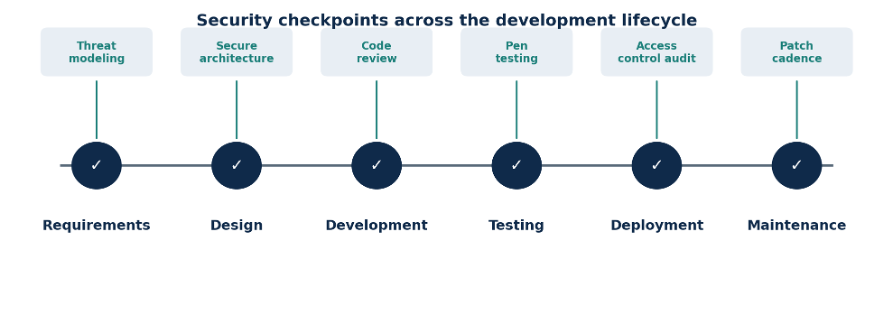
Main image: security checkpoints run through every stage of the development lifecycle, not just the end.
The tech vendor market has reshaped itself over the past few years, and price stopped being the whole story. Some regions built a reputation on being cheap. Others built one on process discipline instead: real audits, senior engineers, security practices folded into the sprint, not tacked on at the end. Teams researching software development companies in Ukraine usually land there for the second reason. A talent pool that spent years building for regulated, high-stakes industries, long before “secure by design” became standard vocabulary in enterprise RFPs. Does that reputation hold up for a specific vendor? Not automatically, and that’s the part worth digging into.
Why Security Matters When Choosing a Development Partner
Outsourcing development doesn’t remove your security risk — it redistributes it. The vendor inherits your attack surface the moment it touches your codebase. A contractor with sloppy access controls, an unpatched CI/CD pipeline, or engineers who paste snippets into random tools becomes your liability.
Financial platforms hold payment data that a single SQL injection can hand to the wrong crowd. Healthcare software touches records protected under laws with real teeth. Even a mid-sized SaaS company, with none of that regulatory weight, can lose a year of customer trust in one breach headline. The cost of a mistake compounds fast enough in these categories that security credentials deserve roughly the same weight in vendor selection as hourly rates.
A vendor without a public certification can still be the right pick. The burden of proof just moves to them. A vendor without a public certification isn’t automatically disqualified, but the bar gets higher: they need to show concrete evidence in its place — a documented code review process, audit logs, a routine scanning cadence — since certification itself is often the baseline clients expect.
What to Look for in Software Development Companies for Secure Projects
Certifications are the easiest signal to check first. ISO 27001 and SOC 2 both require third-party audits, so ask for the actual report. If a vendor can’t produce one, ask what they lean on instead, whether that’s a documented code review policy, routine dependency scanning, or a regular penetration-testing schedule.
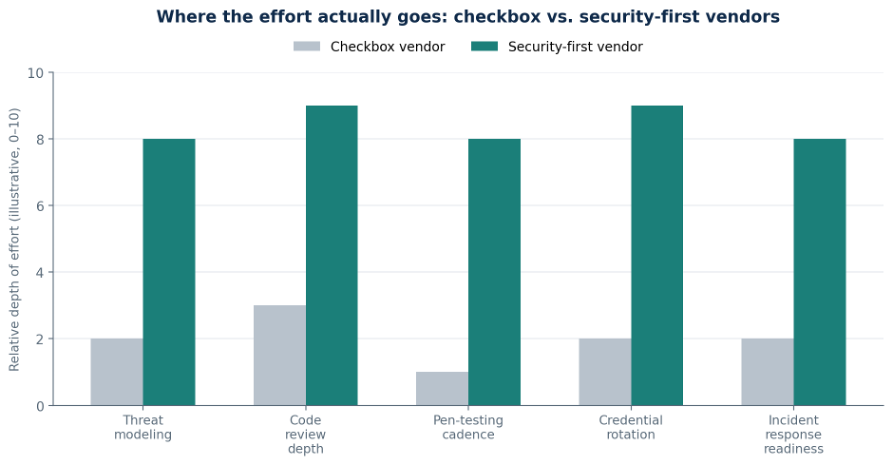
Checkbox compliance and security-first delivery can look identical on paper; the gap shows up in day-to-day practice.
Process matters just as much. Does the team run static analysis on every pull request, or only when there’s time? Do they rotate credentials, or does one shared password sit in a spreadsheet somewhere nobody admits to owning? These are straightforward questions, and the response tells you plenty: a team with this work built into its process usually has an answer ready. A team without it tends to stall, or points to a generic security-policy PDF nobody’s touched since 2019.
Team structure gets less attention than it should. A security engineer embedded directly in the delivery team catches problems a generalist developer, however skilled, tends to miss. However, when a vendor treats security as a separate audit bolted onto the end of a project, vulnerabilities are more likely to emerge after launch.
Why Software Developers in Ukraine Are Considered for Secure Projects
Ukraine’s software industry built its security-first reputation through experience. A large share of software developers in Ukraine came up through defense, telecom, and fintech projects, where a missed vulnerability meant more than a bug ticket — it meant real consequences for the team responsible. That background changes how a team approaches a new codebase. Threat modeling happens before the sprint starts, as a default, not something a client has to specifically request.
The country’s education system reinforces this. Kyiv, Lviv, and Kharkiv all run strong computer science and cybersecurity programs, and that talent pipeline goes directly into companies that provide outsourced development services. English proficiency across the workforce is strong and it’s treated as a baseline requirement for engineers, not an afterthought — which matters on complex projects where precise communication affects the outcome.
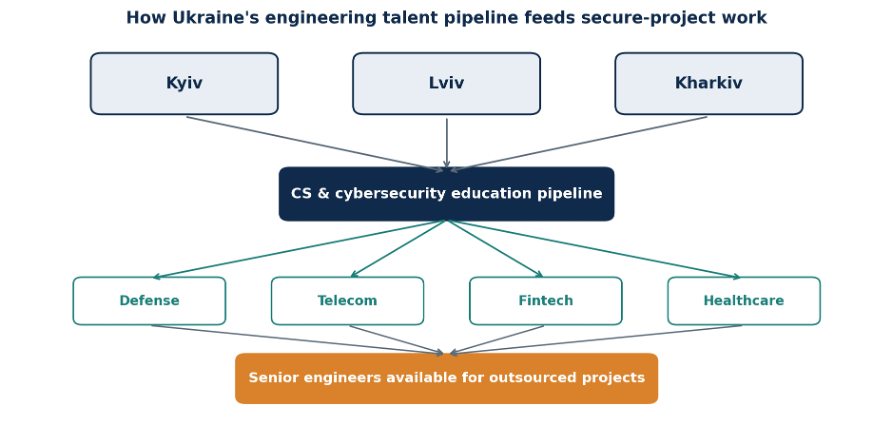
Education hubs in Kyiv, Lviv, and Kharkiv feed engineers into exactly the sectors that treat security as non-negotiable.
Scale plays its part too. Software development in Ukraine ranks among the largest outsourcing markets in Central and Eastern Europe, with tens of thousands of engineers spread across product and outsourced work. A firm with the right focus treats embedded security work, compliance-heavy fintech builds, and hardware-adjacent firmware as routine, not a stretch assignment.
How to Evaluate Ukraine IT Companies Before Choosing a Partner
Reputation research starts the way it always has: case studies and a close look at what the company has actually shipped. Ask for a reference from a client in a similarly regulated space, if one applies to your project. A vendor that’s built for fintech before will handle your fintech project very differently than one making that leap for the first time.
Ukraine IT companies vary enormously in size and specialization. That range works in your favor: it makes it possible to find a niche fit — a smaller shop specializing in high-regulated industries, or one built specifically around embedded and AI development — rather than a generalist that treats your project like every other one.
Check a tech vendor’s location too. Some Ukrainian firms run fully distributed teams; others keep delivery centered in one or two cities with strong local infrastructure. Neither model wins by default. It just changes how a vendor manages communication, time zones, and business continuity when power or connectivity gets disrupted. Ask directly how a vendor handled outages over the past two years; the answer is as telling about operational maturity as a certification is about process discipline — look for both.
Finally, run a small paid pilot before committing to anything larger. A two-to-four-week scoped task, with security review built in from day one, surfaces process gaps no sales call ever will.
Choosing the Right Partner for Secure Software Development
How do you know a team lives up to its security claims, instead of just listing them in a pitch deck? Do they patch fast, or let a known issue sit for a sprint or two? Do they answer uncomfortable questions honestly, or dodge? Is their SOC 2 report current, or three years stale?
Ukraine has built a genuine case for itself in the secure software development niche, backed by education pipelines, defense-adjacent engineering experience, and a market large enough to specialize deeply. That reputation is a reason to shortlist a vendor, not a reason to skip the checks below. Ask for the audit report. Run the pilot. Talk to a reference client.
Get that part right, and you’re not just hiring a vendor — you’re picking a partner who takes ownership of the project as if it were their own.


