


Clinical
Research
Discover the latest research and insights on how VR is transforming healthcare and enhancing therapeutic outcomes.

Cognitive Behavioral Immersion for Depression: VR outperforms flat-screens in randomized controlled trial

Our RCT proves that live peer social support groups, delivered through the Innerworld application, is effective in treating depression. Further, VR headsets were found to be the most effective treatment modality when compared to a control and a mobile phone version of Innerworld (“flat screen”).
This chart shows adjusted mean depression scores (PHQ-9) across the 8-week intervention for three groups: CBI delivered via VR headset, CBI via flat-screen device, and a delayed access control.
All three groups received the same coach-led CBT program — same sessions, same coaches, same content — isolating the effect of device modality. VR users improved significantly faster.
The sense of environmental presence (feeling physically “in” the virtual space) statistically mediated VR’s advantage — identifying the specific mechanism through which immersive VR works better.
Source: Ezawa, I., Ramos, F., Hollon, S. D., Han, G. T., & Robinson, N. (2026, March 27). Cognitive Behavioral Immersion for Depression in the Metaverse: Virtual Reality Outperforms Flat-Screens in Randomized Controlled Trial. Retrieved from osf.io/preprints/psyarxiv/nz5hk_v1

First controlled evidence of its kind
The first RCT to directly compare VR vs flat-screen delivery of the same mental health program — same coaches, same content, same sessions — isolating the unique contribution of immersive technology to clinical outcomes.
Chronic Pain Rehabilitation in VR: Immersive sessions outperform in-person visits in peer-reviewed study
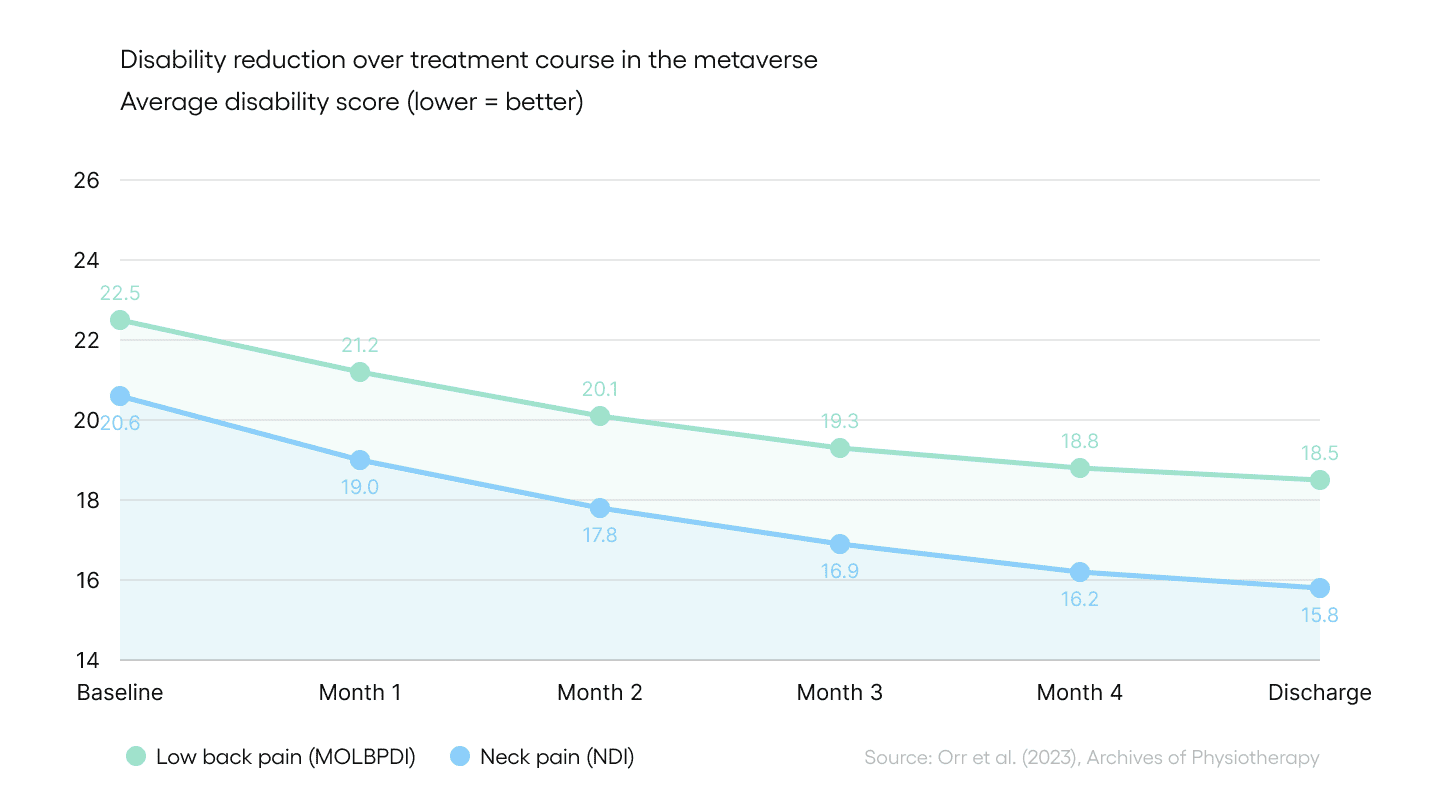
This chart shows the reduction in disability for patients with low back and neck pain treated exclusively through virtual reality sessions in virtual reality — without a single in-person visit.
XRHealth’s platform delivers exercise therapy through immersive VR. Disability was measured using validated clinical scales at baseline and across multiple follow-up points.
Clinical Studies on the XRHealth Platform
- All
- Cognitive Rehabilitation
- Mental Health
- Physical Therapy
Cognitive Behavioral Immersion for Substance Use Disorders: A Feasibility and Pilot Study of a Peer-Based Coaching Program in the Metaverse
Cognitive Behavioral Immersion for Depression: Protocol for a Three-Arm Randomized Controlled Trial of Peer-Based Coaching in the Metaverse
Examining Predictors of Depression and Anxiety Symptom Change in Cognitive Behavioral Immersion: Observational Study
Virtual reality delivered exposure for fear of needles: a small-scale pilot. (2025).
Virtual reality-based Mindfulness-Oriented Recovery Enhancement (MORE-VR) as an adjunct to medications for opioid use disorder: a Phase 1 trial. (2024).
Developing an automated VR cognitive treatment for psychosis: gameChange VR therapy. (2020).
Participatory design to create a VR therapy for psychosis. (2021).
Automated Virtual Reality Cognitive Therapy (gameChange) in Inpatient Psychiatric Wards: Qualitative Study of Staff and Patient Views Using an Implementation Framework. (2022).
Virtual reality (VR) therapy for patients with psychosis: satisfaction and side effects. (2022).
A Safe Place to Learn: Peer Research Qualitative Investigation of gameChange Virtual Reality Therapy. (2023).
Estimating the Economic Value of Automated Virtual Reality Cognitive Therapy for Treating Agoraphobic Avoidance in Patients With Psychosis: Findings From the gameChange Randomized Controlled Clinical Trial. (2022).
Agoraphobic avoidance in patients with psychosis: Severity and response to automated VR therapy in a secondary analysis of a randomised controlled clinical trial. (2022).
Automated virtual reality therapy to treat agoraphobic avoidance and distress in patients with psychosis (gameChange): a multicentre, parallel-group, single-blind, randomised, controlled trial in England with mediation and moderation analyses. (2022).
A multicenter feasibility randomized controlled trial using a virtual reality application of pain neuroscience education for adults with chronic low back pain. (2024).
Pain Neuroscience Education Delivered Through Virtual Reality for Common Musculoskeletal Conditions Seen in Physical Therapy: An Exploratory Study. (2023).
Case Report: Pain Neuroscience Education Using Virtual Reality. (2019).
Virtual reality in the management of health conditions for people aged 65 years and older: A retrospective analysis. (2023).
Balancing new technology: Virtual reality for balance measurement case report. (2023).
Virtual reality in the management of patients with low back and neck pain: a retrospective analysis of 82 people treated solely in the metaverse. (2023).
Virtual reality in the management of stress and anxiety disorders: A retrospective analysis of 61 people treated in the metaverse. (2023).
The Feasibility and Acceptability of Virtual Environments in the Treatment of Childhood Social Anxiety Disorder. (2014).
Feasibility of a virtual reality program to treat children with fear of darkness with nonexpert therapists. (2019).
Treatment of attention deficit hyperactivity disorder in adults using virtual reality through a mindfulness programme. (2017).
Realidad Virtual para superar los miedos. (2018).
Virtual reality with distractors to overcome public speaking anxiety in university students. (2022).
Evaluación sobre la eficacia de la terapia con realidad virtual en menores y jóvenes sujetos/as a una medida judicial de internamiento terapéutico que presentan problemas en el control de impulsos. (2022).
Cognitive Behavioral Therapy (CBT) and (VR) Virtual Reality for Enhanced Therapeutic Outcomes: Exposure Therapy
Cognitive Behavioral Therapy, Prolonged Exposure Therapy, and EMDR in the Assessment and Treatment of PTSD using Virtual Reality
Justifying the Integration of Virtual Reality in Cognitive Behavioral Therapy: A Comprehensive Analysis of Return on Investment
The Applications of AI-Enhanced XR in Patient Diagnostics, Therapy, and Remote Monitoring
Remotely conducted versus office-based virtual reality treatment for fear of flying. 52nd Annual Convention of the Association for Behavioral & Cognitive Therapies. (2018).
Remotely conducted versus office-based virtual reality treatment for aviophobia: Questions of feasibility and accessibility. (2021).
Realidad virtual (RV) como estrategia de intervención innovadora: mindfulness mediante RV en niños con TDAH. (2017).
Treatment of attention deficit hyperactivity disorder in children using mindfulness and VR. (2019).
Efficacy of a mindfulness-based programme with and without virtual reality support to reduce stress in university students: A randomized controlled trial. (2021).
COVID-19 and mental health: A review and the role of telehealth and virtual reality. (2020)
Mindfulness mediante realidad virtual en niños recientemente diagnosticados de TDAH vs programa de mindfulness estándar. (2019).
Feasibility and patient satisfaction of the use of virtual reality during office hysteroscopy. (2021).
Prueba piloto de aplicación de la realidad virtual para el manejo del dolor y la ansiedad anticipatoria en pacientes de hemodiálisis. (2021).
Virtual reality as an adjunct to anesthesia in the operating room. (2019).
Aplicación De Un Programa De Realidad Virtual Como Herramienta De Reducción De La Ansiedad Anticipatoria a Una Sesión De Quimioterapia. (2022).
Reliability Comparisons of Cervical Active Range of Motion Measuring Methods: Universal Goniometer versus Virtual Reality. (2022).
Game-Based Virtual Reality Interventions to Improve Upper Limb Motor Function and Quality of Life After Stroke: Systematic Review and Meta-analysis. (2020).
Gamification of Cervical Spine Physiotherapy by Virtual Reality Software: Is This Real Rehabilitation? (2023).
Virtual Reality Combined with Artificial Intelligence (VR-AI) Reduces Hot Flashes and Improves Psychological Well-Being in Women with Breast and Ovarian Cancer: A Pilot Study. (2022).
The Design, Development, and Testing of a Virtual Reality Device for Upper Limb Training in People With Multiple Sclerosis: Single-Center Feasibility Study. (2022).
Highlighting hybridization: a case report of virtual reality-augmented interventions to improve chronic post-stroke recovery. (2022).
XRHealth continues to invest in rigorous clinical evidence across its therapeutic areas
We actively support and participate in clinical research to better understand the outcomes, mechanisms, and real-world impact of VR-delivered therapy.
Partner with us
If you represent a healthcare system, academic institution, or clinical practice interested in co-designing or participating in a prospective trial, connect with us!
Contact us at: research@xr.health